
A Principled Pragmatic Approach allows Water Diplomats to Move from a World of Seemingly Infinite Possibilities Towards an Actionable Subset of Implementable Ideas We began this series by arguing that many important contemporary water problems emerge from a complex coupling of natural and human systems. In our second post, we argued that Water Diplomats […]

Orienting Interdisciplinary Collaboration for Actionable Outcomes
An Argument for Problem-Driven Interdisciplinary Collaboration for Complex Water Issues In our first post in this series, we argued that many of our current and emerging water problems arise from the inherent complexity of coupled natural and human systems. In our second post we discussed the importance of correctly identifying whether or not a […]
To Address the Problem, First Classify the System
Natural or Human? Complicated or Complex? Why does it matter? In our earlier post, we discussed how the widespread promotion of interdisciplinary water management has not come with an instruction manual on what to do and how. We recognize that many of our water problems arise from a coupling of natural and human systems. Historically, […]

From Universal Optimizers to Principled Pragmatists: How Complexity is Shaping Professional Water Practice
In the 1960s, we addressed our water problems with reservoirs, dams and treatment facilities. At that time, a water professional’s desired outcomes could all be written down and quantified in objective functions. Today, our World is globalized. Science, Policy, and Politics are interdependent. Change is inevitable. The pace and nature of change has accelerated […]

Value Creation in Transboundary Water Negotiations
As we mentioned in our fourth post, Stakeholder Assessment is a useful tool for ‘mapping’ overlapping and conflicting demands for the same water. But once basic requirements have been met (i.e., in terms of quantity and quality of water), how should the relevant parties organize their interactions? Does each side push ahead and seek to […]
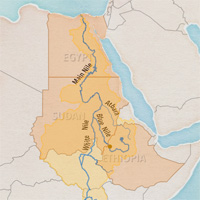
Where Complexity and Uncertainty Prevail, Joint Fact-Finding May Provide a Way Forward
In our last post, we described the value of a carefully structured Stakeholder Assessment as a tool for identifying relevant stakeholders, as well as their interests, in a conflict. It can also be used to identify facts in contention or missing information– i.e. ‘what the parties know or think they know about the problem?’ In […]
Engaging Stakeholders in Sustainable Groundwater Management in California
Water is used for agricultural purposes, household needs, energy generation, transportation, recreation, and environmental protection. If there were an unlimited supply of high quality water available all the time, there would be no need to prioritize among these competing uses. However, as demand outstrips supply and uncertainty about how much water there will be in […]
Ideals, Ideas and implementation of Interdisciplinary Scholarship: Tufts Experiment in Water Diplomacy Theory and Practice
The Academy – founded by Plato and transformed into the modern University – is an ideal institution to cultivate, create, and disseminate universal knowledge. Water Diplomacy is an idea – conceived by a group of reflective water scholars and professionals in Boston in 2006 – with an ambitious goal to explore new ways to “think […]
Is Principled Pragmatism a Viable Framework for Addressing Complex Problems?
Complex problems are connected with many competing and often conflicting values, interests, and tools. These problems can’t be addressed through simply applying dogmatic principles or a deal-making purely pragmatic approach. Because these problems are interconnected and interdependent, a final solution can’t be pre-specified. Any intervention to a complex problem requires attention to both principles and pragmatism. […]


Emergence, Self-Organization and the Commons: Analyzing Complex Water Management Problems
Challenging the Public/Private Dichotomy of Water Management Cochabamba, Bolivia is famous for its 2000 “Water Wars”, in which a popular revolt successfully fought to throw out Bechtel Corporation and rejected the World Bank’s privatization scheme for urban water systems in the country. The Bechtel subsidiary had imposed dramatic price increases overnight that led to […]