
Water is used for agricultural purposes, household needs, energy generation, transportation, recreation, and environmental protection. If there were an unlimited supply of high quality water available all the time, there would be no need to prioritize among these competing uses. However, as demand outstrips supply and uncertainty about how much water there will be in […]



Emergence, Self-Organization and the Commons: Analyzing Complex Water Management Problems
Challenging the Public/Private Dichotomy of Water Management Cochabamba, Bolivia is famous for its 2000 “Water Wars”, in which a popular revolt successfully fought to throw out Bechtel Corporation and rejected the World Bank’s privatization scheme for urban water systems in the country. The Bechtel subsidiary had imposed dramatic price increases overnight that led to […]
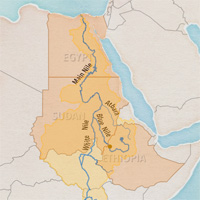
Coping with Uncertainty and Feedback in the Nile Basin
This article is the second installment of the series Water Diplomacy: Issues of Complexity Science and Negotiation Theory — Water disputes are difficult to resolve because they are complex. These disputes occur in open and changing systems with numerous stakeholders, interactions, and interdependencies that make it difficult to anticipate or manage complex systems. One aspect of complexity has to do with uncertainty in how the networks and systems involved are likely to respond to stresses, such as

Issues of Complexity Science and Negotiation Theory (an annotated and evolving bibliography)
Water access, demand, usage and management become complex due to the crossing of multiple boundaries: political, social and jurisdictional, as well as physical, ecological and biogeochemical. The complexity of many water issues lie in the interconnections and feedbacks among variables, processes, actors and institutions operating in the knowledge and political communities. Consequently, many water management […]
Exploring the Interconnections and Interdependencies at Play in California’s Water Problem
This article is the first installment of the series Water Diplomacy: Issues of Complexity Science and Negotiation Theory — Farmers in California’s Central Valley prominently display signs along the highway reading “Congress created this dustbowl,” while, in Los Angeles, the water conservation mascot “Lawn Dude”, prominently displayed on billboards in and around the city, reminds residents to stick within regulated limits for watering their lawns. Though the drought itself is not record-breaking, a combination of severe groundwater depletion, water shortages along the Colorado River, and rising heat (and thus evaporation) have created a critical water supply problem for the state
Water Diplomacy: Issues of Complexity Science and Negotiation Theory
Water access, demand, usage and management become complex due to the crossing of multiple boundaries: political, social and jurisdictional, as well as physical, ecological and biogeochemical. The complexity of many water issues lie in the interconnections and feedbacks among variables, processes, actors and institutions operating in the knowledge and political communities. Consequently, many water management […]